Why This Exists

Publishers are starting to ask authors to prove a book was written by a person, not generated wholesale by a language model. Today, that bar is mostly self-attestation: a checkbox, an honor system. And it's rising fast.

Why not just track keystrokes?

It's the obvious first idea, and it's the wrong one. Research has already demonstrated forgery attacks against keystroke-timing verification, and found that timing data alone carries no real information about who authored the text. It proves a human was present, not that they wrote this. Verified Writing tracks something harder to fake instead: whether a manuscript grew progressively, in a specific unbroken order, over many recorded sessions, and whether that recorded history has been rewritten since.
How It Works

Every save, whether autosave or manual, plus a paste event if there was one, adds one entry to a project-wide ledger. Each entry is small: a word count, a timestamp, a paste-character count, and two hashes.

A chain, not a log

Core

Each new entry's hash is built from its own content and the hash of the entry before it, chaining every save to everything that came before. Edit any single entry, even one from months ago, and every hash computed after it stops matching. There's no way to quietly patch history without the mismatch showing up the moment someone checks.

The formula:

# each link's hash folds in everything before it link_hash = SHA256( prev_link_hash + content_hash ← hash of your prose, not the raw file + timestamp + word_count + pasted_chars )

Always On, No Setup

There's no switch to find and no step you can forget. Every project starts its ledger the moment you create it, and nothing about the process changes what you type or how you write — it just keeps a quiet record alongside your prose. It's still honest about partial history: if a project existed before this ledger did, tracking picks up from today's word count on its next save, not a false claim of continuity back to page one.

The Ledger

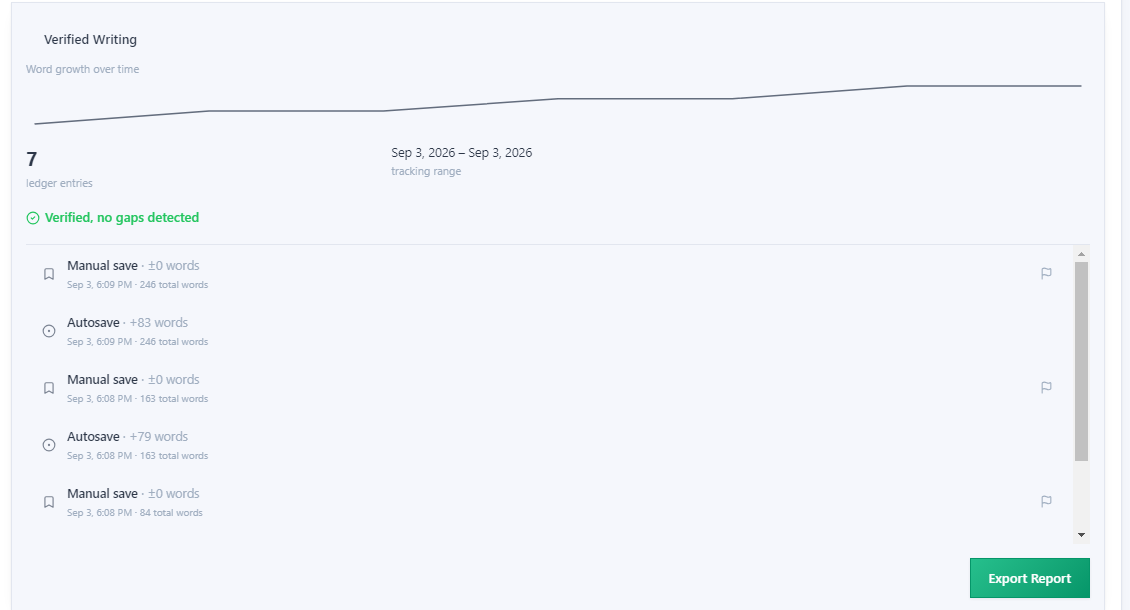
Every project with Verified Writing on has its own panel: a word-growth curve across every recorded save, the full list of entries newest-first, and a live status check, a simple green "Verified" the moment the chain is confirmed intact.

The Verified Writing ledger panel, showing a word-growth sparkline, entry count, tracking range, a green verified status, and a list of individual save entries

Word growth over time, a verify-status check, and every save laid out newest first.

Milestones

Flag any manual save as a milestone, such as "first full draft," the same way you already lock a version today. It surfaces at the top of your Authorship Report.

Replay

Jump into any manual checkpoint of the document you have open and see a real before/after diff, with added text highlighted and removed text struck through.

A Signed Report, Checked Inside Alistair

Export Report builds one JSON file: your project's ledger in full, a word-growth curve per document, paste statistics, and a plain-English summary — then signs it with a private key that only lives inside Alistair. If any Compile History PDF snapshots were archived during the ledger's tracked span, the report lists those too, corroborating evidence that ties a specific compiled manuscript to a specific point in the recorded writing history.

Verify

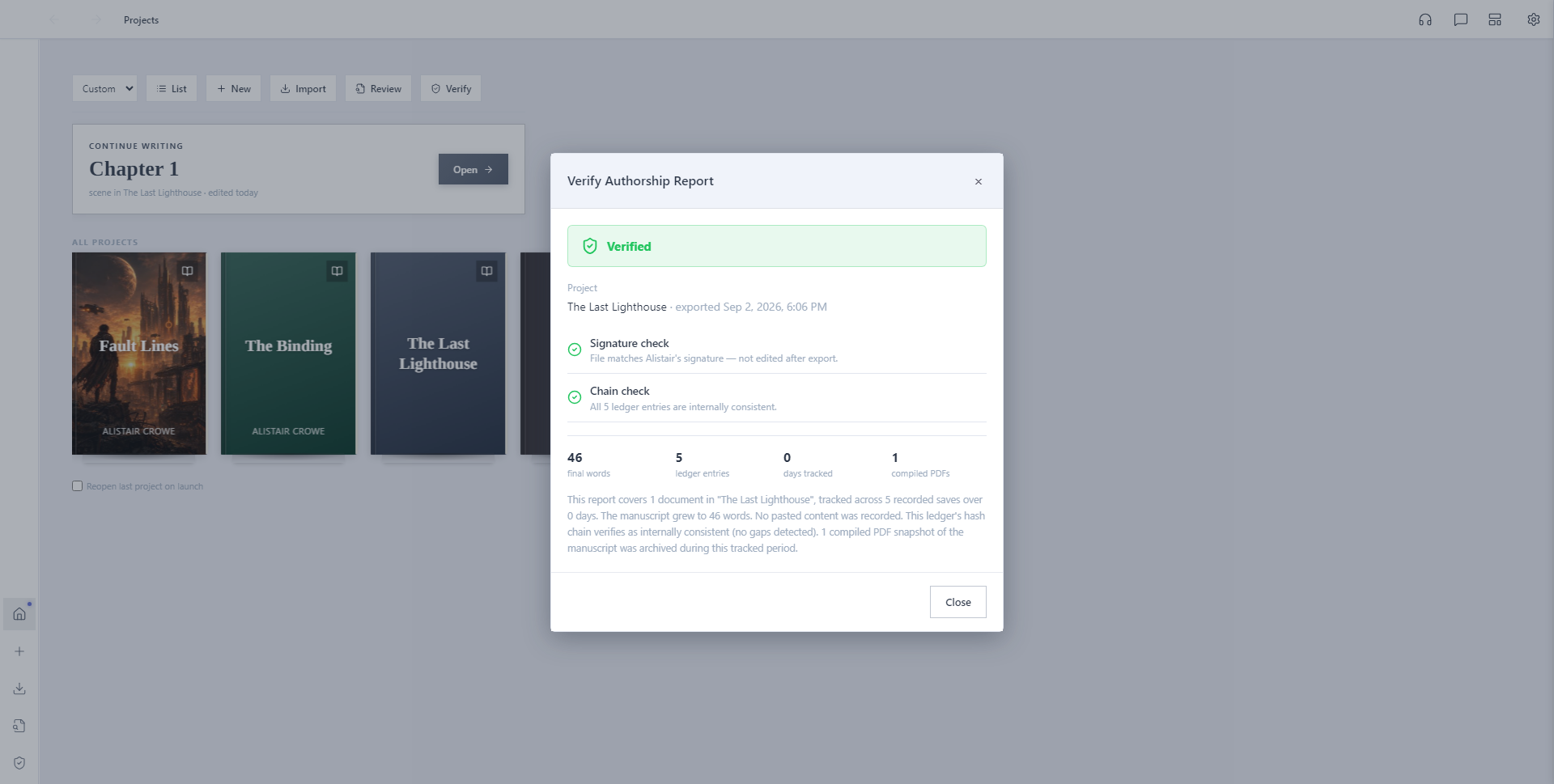
Verify in the toolbar opens a file picker, checks the file's signature (proof it wasn't hand-edited after export) and recomputes the hash chain (proof the history wasn't rewritten), and shows the result right there — final word count, entry count, tracking span, and any compiled PDF snapshots that fall within it.

The in-app Verify Authorship Report result, showing a green Verified status, signature and chain checks, and stats including final words, ledger entries, days tracked, and compiled PDFs

Verifying in-app: signature and chain both pass, and one compiled PDF snapshot falls inside the tracked period.

What This Honestly Proves

Tamper-evident, not tamper-proof.

This proves the recorded history is internally consistent: nothing in it was quietly rewritten. It does not, and can't, prove that no other history could ever have existed, or stop someone with full access to their own machine from building a fake one from scratch. We'd rather say that plainly than oversell it.

By design, Verified Writing never looks at what you typed, and it never tracks which tools you used to write it. It only records that the words grew, over time, the way real writing does.

Fully offline, on purpose.

Alistair is a fully offline application, and Verified Writing doesn't bend that rule. There's no cloud timestamping authority in the loop and no phone-home. Nothing leaves your machine until you choose to export a report yourself. Your manuscript text itself never leaves the project file, whether Verified Writing is on or off. Only word counts, timestamps, and hashes are recorded, never the words themselves.